A few weeks ago, Fast Company ran a piece called "Brands vs. bots" a tour of how CMOs at Ally, Philips, and the agencies serving them are scrambling to figure out how their brands show up inside ChatGPT, Claude, and Gemini. It's a smart piece. If you run a $50M+ brand, read it.
But it buries the real story.
The Fast Company piece does land a few important truths.
LLMs pull from everywhere: your owned site, your PDPs, what your execs say on LinkedIn, what customers say on Reddit, what major publications say about you, the alt text on your product photography. Sixty to sixty-five percent of AI citations come from your own content, says Anomaly's chief AI officer Chris Neff. Owning your owned media matters more than ever, not less.
LLMs reward clarity. Brad Nunn at Gale put it plainly: the first sentence of your FAQ should mention the brand, name what it solves, and stop. No vagueness, no "imagine if..." copywriting school flourish.
LLMs punish slop. Every CMO interviewed said the same thing: people can smell AI-generated copy now, and so can the models. Quality beats quantity. Human fingerprints matter.
And LLMs reward consistency. Signalness again:
"LLMs are looking at what words are most associated with your brand. That's old-school marketing."
All true. All necessary. None of it is sufficient.
Your brand is underperforming because at any given moment, your own organization is producing twelve different versions of itself.
Your paid social agency writes captions in one voice. Your email team writes flow copy in another. Your PDP descriptions were written three years ago by an intern who is now a dentist. Your founder's LinkedIn sounds like a different company than your homepage. Your customer support replies use vocabulary the brand book explicitly forbids. Your influencer briefs got translated through three Slack threads before the talent recorded the video. Your retail packaging copy was localized for Canada and never translated back.
LLMs don't see one of these. They see all of them, weighted by authority, blended into one statistical impression of who your brand is and what it stands for.
That impression is the only thing a $750B AI-mediated commerce market is going to use to recommend you in 2028.
You can't fix this with a content factory. You can't fix it with monitoring tools. And, you can't fix it by hiring a "Head of GEO" and giving them three FTEs. The CMOs telling Fast Company they're doing weekly scrums with PR, tech, HR, and a dedicated AI team are describing the size of the problem, not the shape of the solution. They're throwing humans at a machine-scale problem. (Besides, most of those brands doing that have the resourcing to throw humans at it).
The real work is operating with the consistency that AI now rewards.
Most brands have a brand book. It's a beautiful 60-page deck. Color tokens, voice principles, a do/don't page, three approved photography styles, and a "tone in the wild" section that nobody on the email team has ever opened.
Brand books are documentation. They describe a brand. They don't run one.
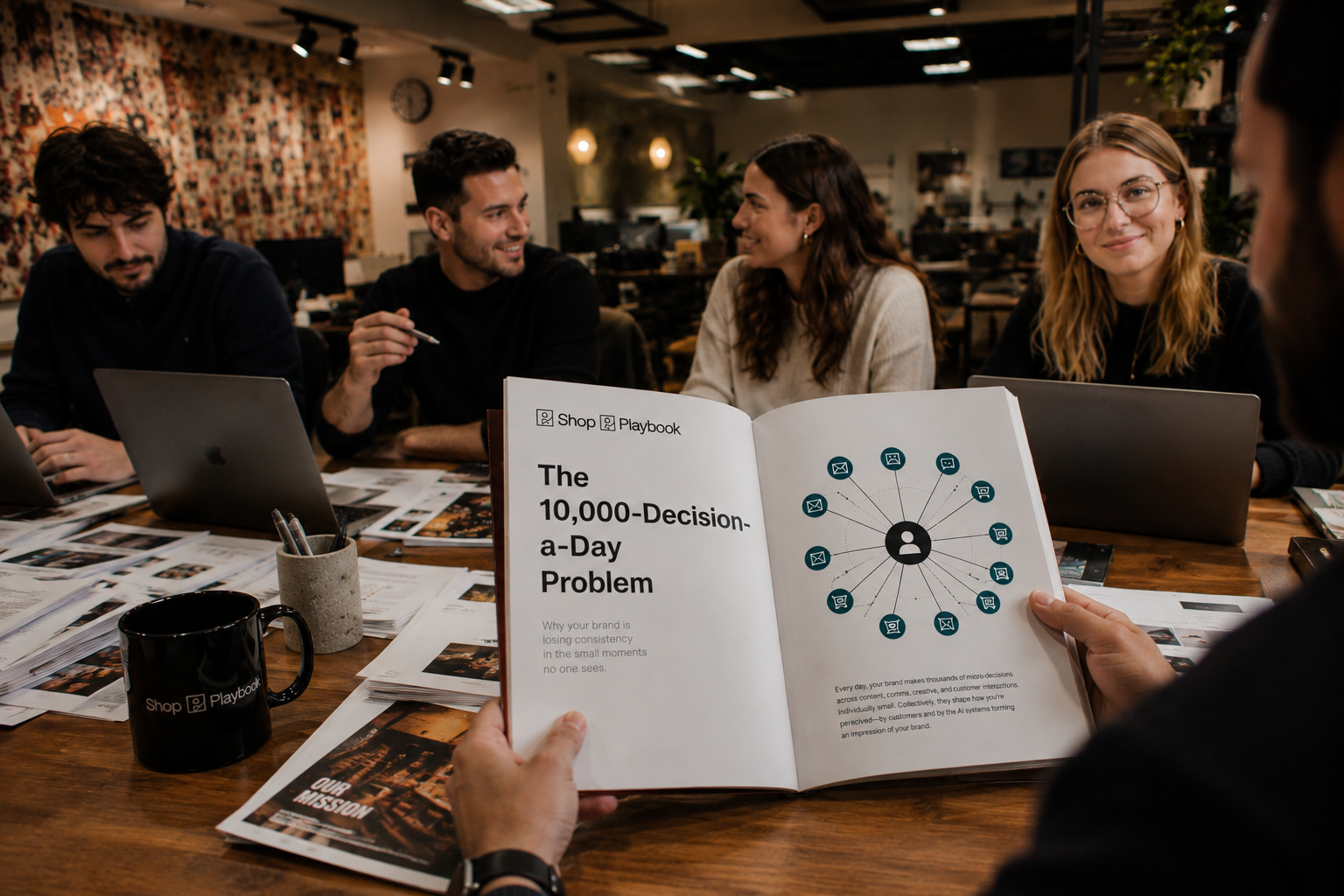
The reason your brand drifts is that every creative decision your organization makes — the caption, the subject line, the alt text, the campaign brief, the new SKU page, the IG story, the support reply, the influencer brief, the gift guide pitch — each one gets made by a human who is moving fast, hasn't opened the brand book in nine months, and is improvising. Multiply that by the 10,000 small decisions a $200M brand makes every day and you get the variance LLMs are now turning into your aggregate brand impression.
A brand agent is your brand framework — your voice rules, your visual judgment, your editorial lens, your merch logic, the way you'd actually answer a customer question, encoded as a live AI agent with a real job inside your stack. It writes the captions in your voice. It briefs the campaign with your editorial lens. It reviews the creative against your visual rules. It drafts the support reply in the exact register you'd want. It sits inside Figma, Klaviyo, Shopify, your CMS, Slack, wherever the work actually happens.
When brand agents run the work, every signal they produce agrees. The captions match the emails match the PDPs match the support replies match the founder's LinkedIn match the new SKU launch match the gift guide. Every surface is the same brand, in the same voice, making the same judgment calls.
That is what an LLM rewards. Not a content team writing 400 blog posts a quarter. A brand that operates with the consistency of a single mind, at the speed and scale of a machine.
This is the line we're betting Shop Playbook on, and I'll say it plainly: most brands have a brand book; the winners have brand agents. We build the second kind.
If that sounds far-fetched, look at where the actual constraint is. Agencies scale linearly with cost. Every new campaign needs more humans. In-house teams hit headcount ceilings. You can't triple the creative team to support triple the revenue. Generic AI tools scale volume but destroy the brand, because they have no idea what your brand sounds like and they're trained on everyone else's.
Brand agents do something different. The framework runs the work. Craft and quality hold as volume compounds. That's how a $100M brand reaches $500M without tripling its creative org. And relevant to this whole GEO conversation: that's how your brand stops drifting across 12 channels and starts showing up to ChatGPT, Claude, Perplexity, and Gemini as one coherent entity.
You don't have to hire us to start.
Three things you can do this week:
Build a structured set of prompts with the 20 questions your buyer is most likely to ask AI: "best [your category] under $X," "is [your brand] worth it," "what do people say about [your brand] customer service," "alternatives to [your brand]." Run them across ChatGPT, Claude, Gemini, and Perplexity. Capture the answers verbatim. The variance between models is your map of where your brand impression is leaking.
Pull 100 pieces of recent customer-facing output across paid, email, organic, PDPs, support, and PR. Score each on a 1–5 voice consistency scale against your brand book. The pieces below 3 aren't just bad copy; they're the signals corrupting your LLM impression. The variance is the leak.
Pick the highest-volume creative decision your team makes every week, usually caption writing, email copy, or PDP descriptions. That's the first job to encode into an agent. Start where the volume is, because that's where the consistency dividend is biggest.
Do those three things and you'll already be ahead of 84% of the market.
The CMOs in the Fast Company piece are right that this is 1998 for search, or 2006 for social. They're underestimating how short the window is.
Once the major LLMs roll out brand-side advertising, and they will by 2027, the playing field flattens. Everyone will be paying to be cited. The brands sitting at the top of every model's recommendation, with or without the ad spend, will be the ones whose brand was already operating with machine-grade consistency before anyone else figured out the question.
There's roughly an 18-month window to put yourself there. The brands that come out of this period with their brand encoded into agents will be hard to catch. The brands that spent it churning out GEO content will be a footnote in next year's Fast Company piece.
Stop optimizing for AI. Start operating like one.
Chelsea Jones is the CEO and Founder of Shop Playbook (legal entity: Agentic Playbook LLC). Shop Playbook builds brand frameworks into AI agents for $50M–$500M DTC brands. If you want a structured look at how your brand is showing up across the major LLMs and where it's drifting, they run a 2-week Creative Ops Audit. Get in touch: chelsea@shopplaybook.com