When a brand is small, the creative director is everywhere. She approves the caption before it goes up. She rewrites the subject line at 11pm. She is in the Slack thread when the agency sends over three options and one of them is clearly wrong. The brand sounds like itself because she is the connective tissue holding it together.
Then the brand grows. There are now four agencies, two in-house writers, a social team, an email team, a PDP copywriter, three influencer partnerships active at any given time, and a customer support org handling 400 tickets a day. The creative director cannot be in all of it. Nobody can.
So the brand starts making decisions without her. Thousands of them. Every day.
Most of those decisions are small: a word choice, a framing call, a tone judgment on a support reply. No single one is catastrophic. But each one that drifts from what the brand actually sounds like is a small deposit into an account of inconsistency. Over months, that account compounds. The brand that sounded singular at $30M sounds like three different companies at $150M, and everyone on the leadership team can feel it but nobody can point to when it started.
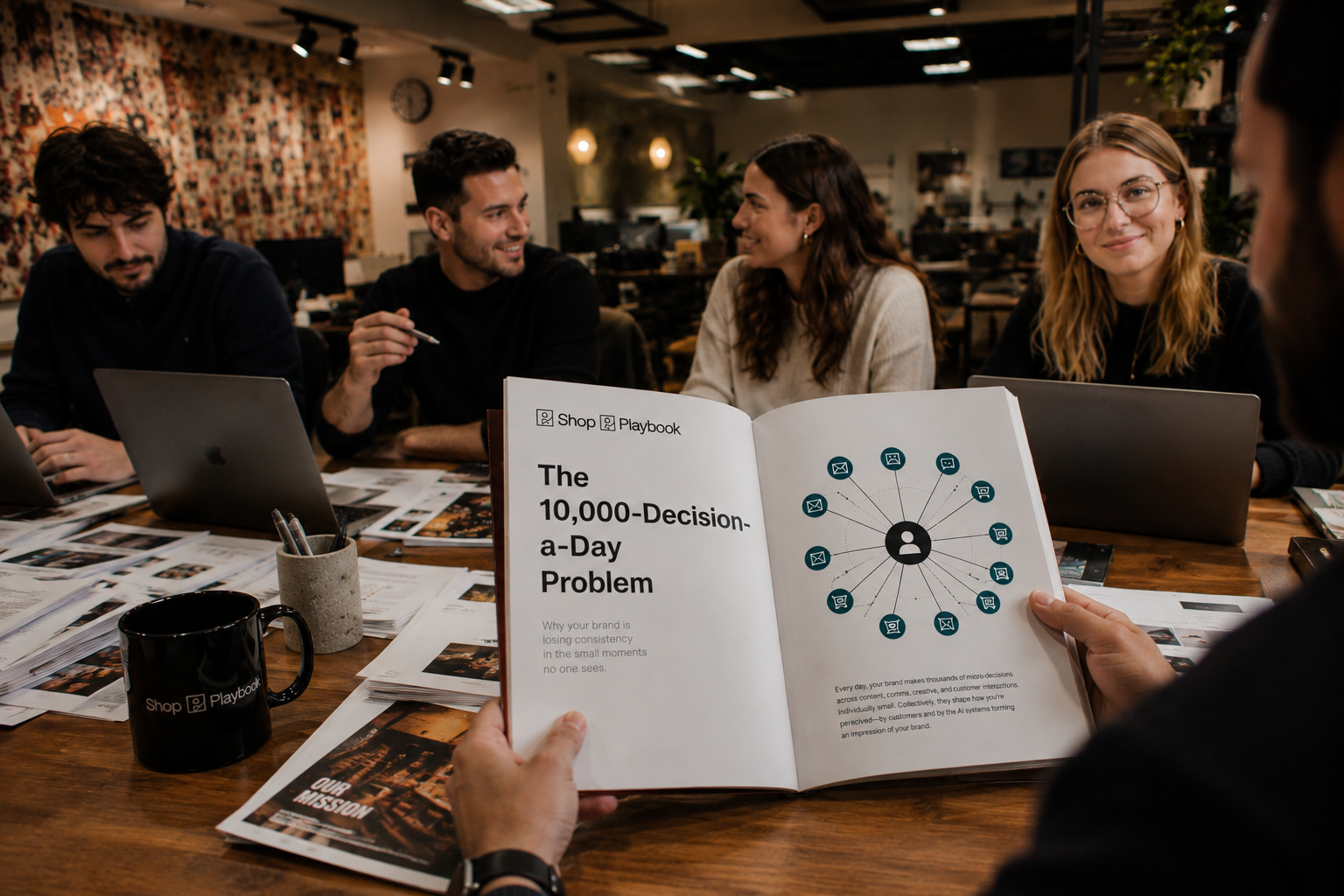
This is the 10,000-decision-a-day problem. And it is the actual reason scaling DTC brands lose their voice.
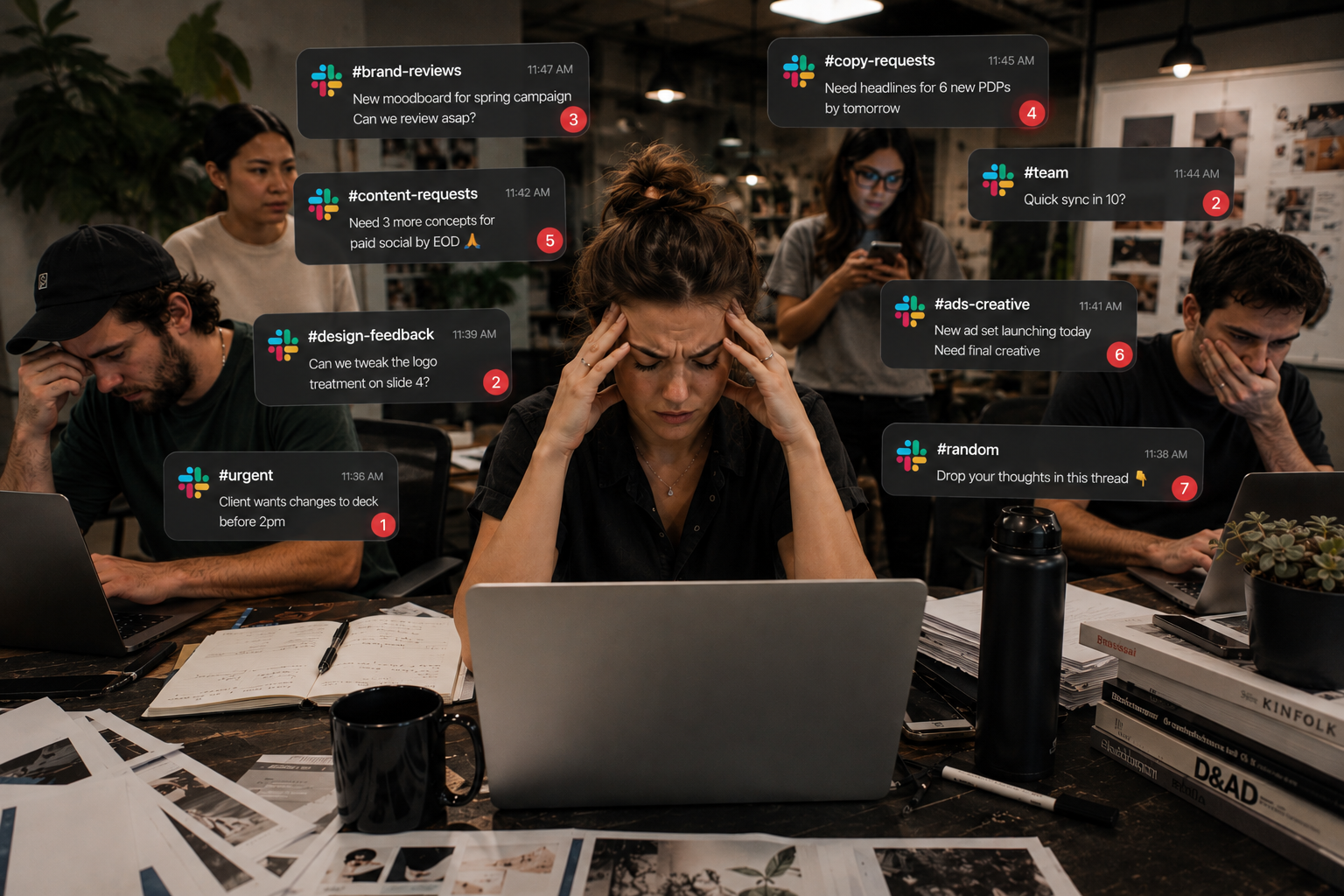
There is a standard playbook for fixing brand consistency: update the guidelines, run a training, build a better review process, hire a brand manager. These things help at the margins. None of them solve the underlying math.
A $200M DTC brand is making somewhere between 5,000 and 15,000 creative micro-decisions per day. A brand manager reviewing output can realistically give meaningful attention to maybe 30 to 50 pieces per day. The decisions your team makes in the hours and channels the creative director cannot reach are being made against each person's best recollection of what the brand sounds like, filtered through whatever deadline pressure exists at that moment.
Better documentation informs. It does not run. More review process works until the volume exceeds the reviewer's capacity, which at a scaling brand happens quickly. Tighter briefs narrow the variance but interpretation still happens on the other end. Every translation introduces drift.
These are human-scale solutions applied to a machine-scale problem.
Brand drift rarely looks like a disaster. The drift is subtler: a slightly different vocabulary set, a tone register that is close but not quite right. A few places it shows up reliably:
Email teams optimize for conversion. Social teams optimize for engagement. By the time anyone notices, the brand sounds warmer and more urgent in email than it does in organic. The customer is encountering two versions of the same brand without realizing it, and so are the LLMs indexing your content.
Every new agency brings their last client's cadence with them. The brief says your brand voice. What ships reflects theirs.
Customer support is the most under-reviewed brand surface at most DTC companies, and often the one with the highest volume. Support replies often read like a generic service voice that has nothing to do with what the brand sounds like everywhere else.

Brand drift has always cost money in the diffuse ways that brand degradation costs money. There is a new cost that is faster and more direct.
LLMs are now the first place a significant and growing share of your potential buyers form their impression of you. The model answers based on everything it has indexed about you. If those signals disagree about what your brand sounds like, the model has low confidence in characterizing you. Low confidence means you get mentioned less, recommended less, cited less.
The brands winning LLM visibility right now are the ones whose every signal agrees. That coherence comes from operational consistency, and operational consistency at scale requires systems, not people.
The answer is not more humans in the chain. The answer is encoding the judgment so it does not need to pass through humans for every decision.
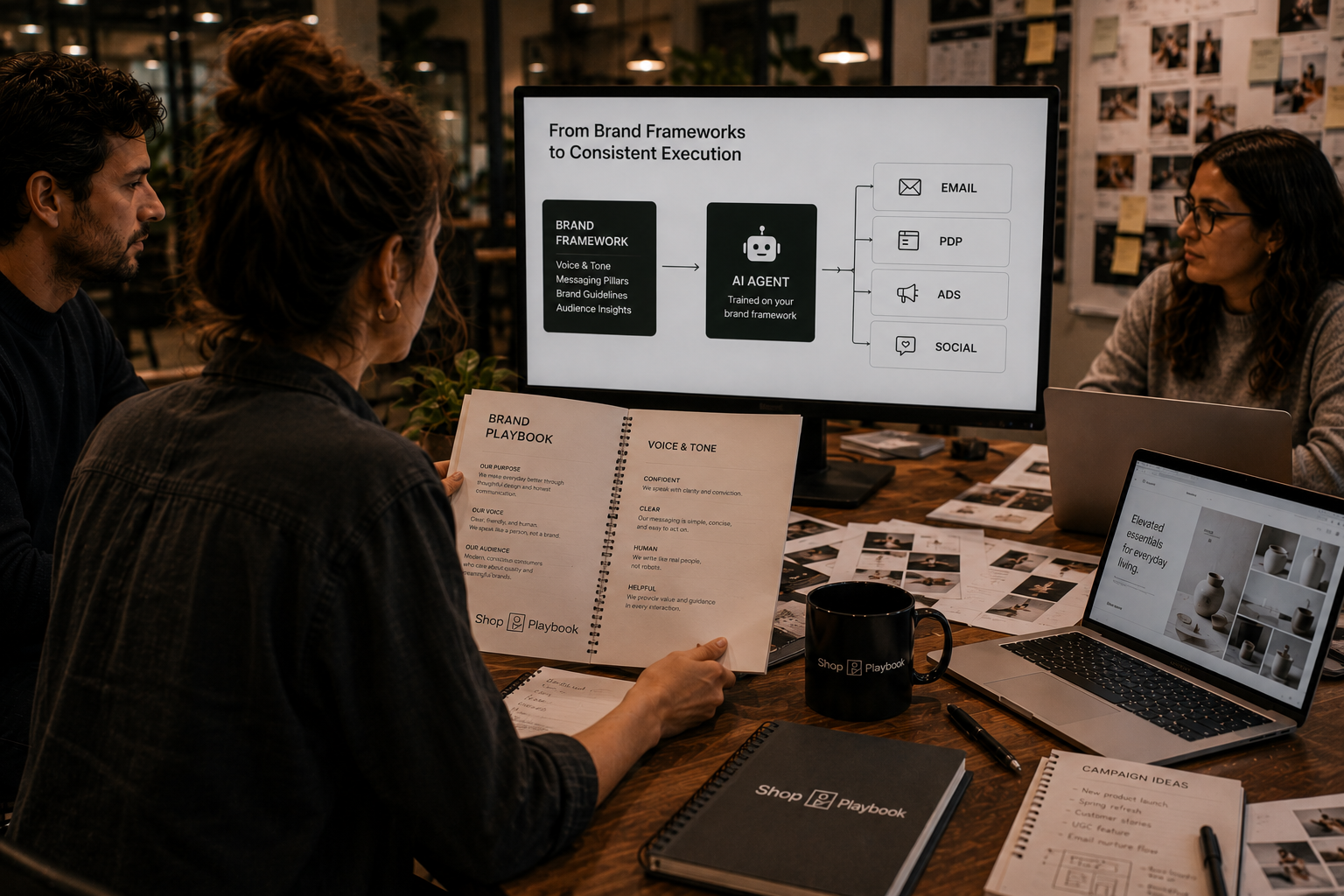
A brand agent encodes your creative director's actual judgment: the sentence structures that are yours, the vocabulary that is in and the vocabulary that is out, the register for a product launch versus the register for a support reply. That logic runs inside the tools where the work already happens. The creative director is not removed from the process. She is elevated in it. The agent handles the 9,800 decisions per day that are executional. She handles the 200 that actually require her judgment.
Start with the highest-volume creative decision in your stack and encode that first. For most DTC brands that is email copy, caption writing, or PDP descriptions. Pick the one where volume is highest and consistency is lowest.
The brands that start this year will be operating at a level of consistency that brands starting in 2027 will not be able to match quickly. The encoding takes time. The compounding starts immediately.
If this sounds like the problem your organization has been circling without naming, reach out at chelsea@shopplaybook.com. The Creative Ops Audit we run is a reasonable starting point: two weeks, structured diagnostic, clear map of where your brand is drifting and what encoding your highest-impact surfaces would look like.
Chelsea Jones is the CEO and Founder of Shop Playbook (Agentic Playbook LLC). Shop Playbook builds brand frameworks into AI agents for $50M-$500M DTC brands.