
This piece is part of a series. If you found it through our earlier article on why most brand visibility problems are actually brand operations problems, welcome back. If you are starting here, that piece is worth reading first.
There is a document somewhere in your Google Drive that has your brand colors, your font stack, a voice section with phrases like "bold but approachable," and a do/don't page somebody spent three weeks on in 2022.
Nobody reads it.
Not the freelancer writing your email flows. Not the paid social agency. Not the person who rewrote your PDPs last quarter. Not the founder's LinkedIn ghostwriter. Not the new marketing hire who has been "onboarding" for six weeks. The brand book exists, it has for a while. The brand, as something that actually runs consistently every day, does not.
That gap has always been expensive. Inconsistent creative costs you in brand equity, in customer trust, in the compounding confusion of sending twelve different signals to the same buyer across twelve different channels. But right now, in 2026, it’s even more expensive in a new way.
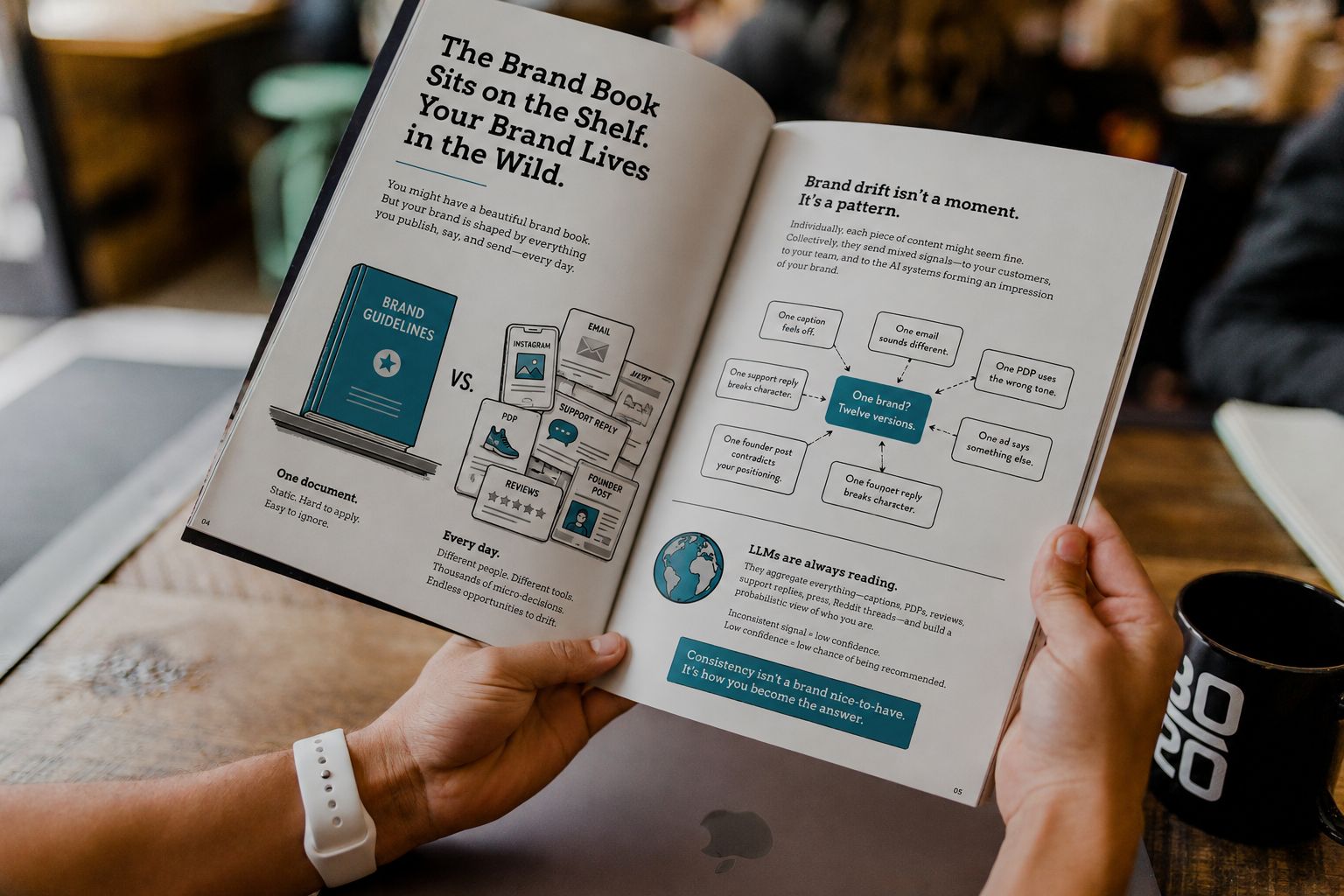
LLMs are reading everything that’s published about yoru brand. Every PDP, every caption, every public support reply, every press mention, every influencer brief that made it onto the internet. They blend all of it into a statistical impression of who you are, what you stand for, and whether you are worth recommending. If your brand is producing twelve different versions of itself, the model's impression is noise. Fragmented signals do not get recommended.
The brands solving this do not hire more people or produce more content. They build brand agents. And the distance between brands that have them and brands that do not is going to widen fast.
Brand guidelines made sense when a company had an agency of redord, one creative director, and a handful of content pieces per month. In that context, a document was a reasonable alignment tool. A small group of humans could read it, internalize it, and apply it.
That is not the operating reality of a DTC brand in 2026.
A $100M brand is producing thousands of pieces of customer-facing content every month: captions, email sequences, SMS, paid ad copy, product descriptions, influencer briefs, UGC response templates, gift guide pitches, retailer decks, customer support replies, founder posts, YouTube scripts, PR placements. Each one gets made by a different person, in a different tool, on a different deadline.
95% of companies have brand guidelines. Only 25 to 30% actively enforce them. That’s a very expensive systems problem. The document was never engineered to run at this volume. It was engineered to inform. Those are different jobs, and confusing them is why brand drift is so common even at brands that genuinely care.
Brand drift is quiet. It is not one bad caption on a social post. It’s a subject line that sounds slightly off, a PDP written in a register your brand book would flag, and an FAQ using vocabulary nobody approved. Individually defensible. Collectively, the signal your brand is sending to every model that indexes it.

A brand agent is not a chatbot. It is not a generic AI writing tool with a custom prompt. It is not a tone checker sitting next to your CMS waiting for someone to remember to use it.
A brand agent is your brand's operating logic, encoded as a working AI system with a specific job inside the tools your team already uses.
Here is what that means practically: Your brand has a documented voice that isn’t just a "playful but authoritative" as a phrase on a PDF, but actual sentence structures, vocabulary choices, and editorial instincts that make your copy sound like you. Your brand has a visual judgment: a way of deciding which image works and which gets cut. A merchandising logic: how you talk about price, how you frame urgency, what you never do. A customer service tone. An editorial point of view on what topics your brand has a right to speak to.
A brand agent takes each of those things and encodes them as operational constraints, not reference text. The agent writes captions in your voice because your voice is built into how it runs, not because it is hoping someone handed it the brand book first. It reviews creative against your visual standards because those standards are part of its decision logic. It drafts support replies in your exact tone because that tone is its default, not an option.
It lives inside Figma, Klaviyo, Shopify, your CMS, Slack. Wherever the work happens. Not in a separate tab someone has to remember to open.
When brand agents run the work, every surface agrees. The caption matches the email matches the PDP matches the support reply matches the founder's LinkedIn. One coherent signal, at scale, across every channel, every week.

Brand operations is one of those problems that tends to fall between job titles. In most organizations, three people share pieces of it without anyone owning it fully.
If you are a CMO or VP of Marketing, the problem shows up as inconsistency you can see but cannot fix through process alone. You can run brand audits, brand awareness studies, hold trainings, update the guidelines. The drift comes back because the volume of decisions exceeds any process built for humans to enforce.
If you are a founder or CEO, the problem shows up at scale. You hit $50M and the brand still sounds like you. You hit $150M and it does not. The creative director's judgment used to stretch across the organization because the organization was smaller. Now it cannot cover the distance. The brand you built is getting diluted by the growth you wanted.
If you are a Head of Brand or Creative Director, the problem shows up as a constant editing loop you cannot get ahead of. You are reviewing output that should never have needed review, correcting drift that should never have happened, and explaining brand standards to people who have heard the explanation before. The bottleneck is you, and it should not be.
Brand agents change the answer for all three. The CMO gets consistency without more enforcement overhead. The founder gets a brand that scales without diluting. The creative director gets out of the approval loop for work the agent handles, and back into the higher-order decisions only they can make. All of it designed to evolve as your brand scales.
A lot of the conversation around AI search optimization right now is about content volume: more FAQs, more structured data, more blog posts written to answer the questions LLMs are likely to surface. That work is not wrong.
But it misses the underlying problem.
LLMs do not evaluate your brand based on your best piece of content. They build a probabilistic model of who you are from everything they can find: your owned content, your reviews, your press, your social presence, what people say about you on Reddit. 37% of consumers now start discovery with AI tools rather than search engines. The impression those tools form comes from the full aggregate of your brand's signal, not a curated sample.
If that aggregate is inconsistent, the model's confidence in recommending you is low. Fragmented signal reads as an unclear brand, and unclear brands do not get cited.
When a brand agent runs your operations, the signal becomes coherent. The same voice, the same vocabulary, the same positioning runs across every surface the model is reading. That coherence is what gets cited. Not the volume of content. The consistency of it.
Every growth path for a DTC brand eventually hits the same wall. You don't triple revenue by tripling output. Even thinking more agencies, freelancers, or software can do the work won’t move the needle, but it will increase your operating expenses.
Agencies scale linearly with cost. Every new campaign needs more humans. In-house teams hit headcount ceilings. Freelancers introduce variance because every new person is another source of drift. Generic AI tools scale volume but destroy voice, because they have no idea what your brand sounds like and they are trained on everyone else's.
None of these scale the brand itself. They scale execution while the brand bleeds out.
Brand agents solve a different problem. The framework runs the work. Craft holds as volume compounds. You go from $100M to $300M and the captions still sound like you. The new product launch still sounds like you. The email flows your team is producing at three times the previous rate still sound like you. The creative director's judgment is running in every channel simultaneously, not stretched across them.
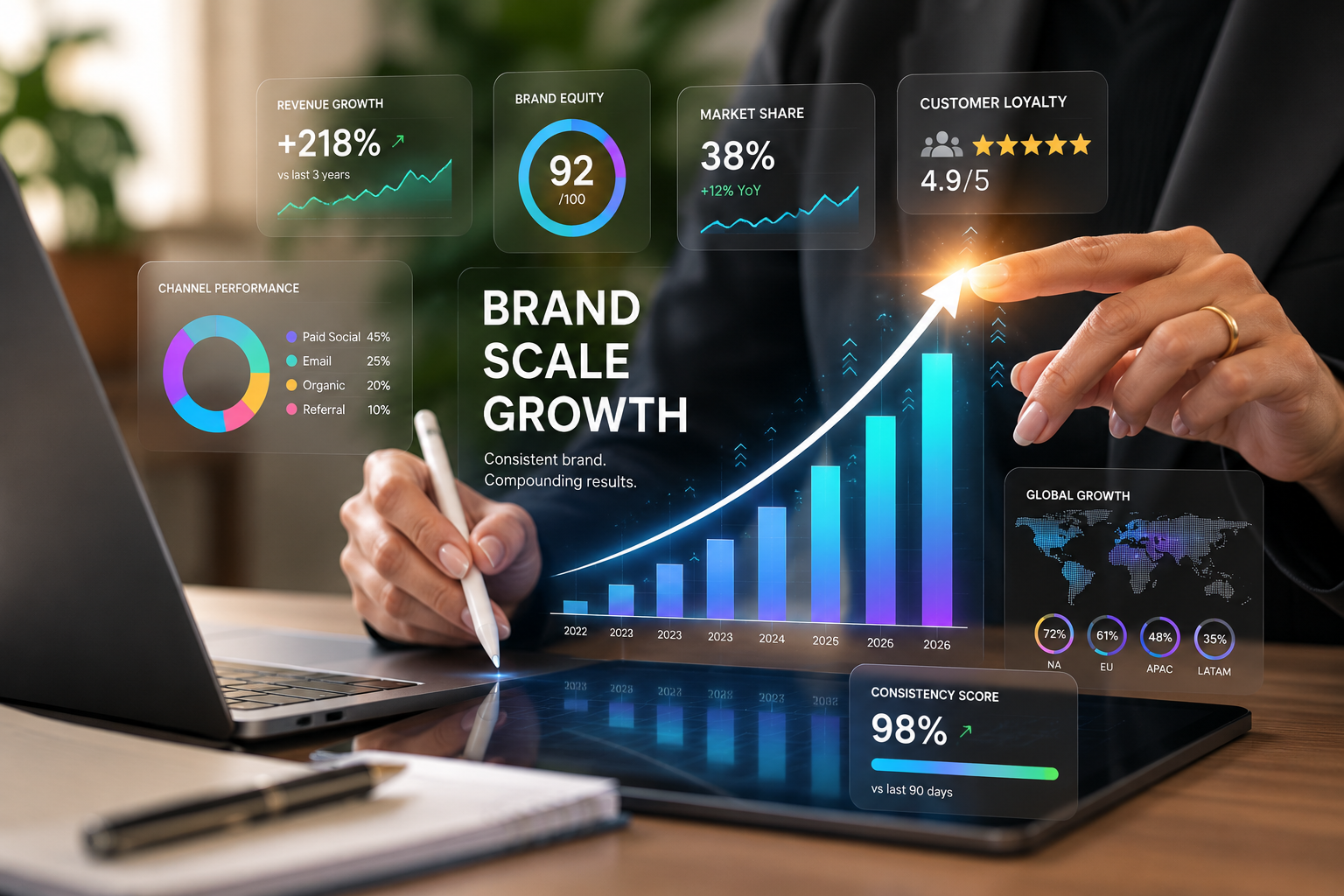
Companies achieving consistent brand presentation see 23 to 33% revenue increases. Only 25 to 30% of brands with guidelines actively enforce them. The gap between those two data points is the opportunity.
A few questions worth sitting with honestly.
Pull 50 pieces of customer-facing copy from the last 90 days: captions, emails, PDPs, support replies. Score each one on a 1 to 5 consistency scale against your brand guidelines. How many score below 3? Those pieces are the signals corrupting your LLM impression.
How many different people made brand-level creative decisions for your business last month? Every person past five is another source of variance you are not controlling.
When you bring on a new agency, hire a new copywriter, or onboard a new marketing lead, how long before their output sounds like your brand? If the answer is months, your brand is not operationally transferable. A brand agent makes it transferable on day one.
Run the same five search queries about your brand across ChatGPT, Claude, Gemini, and Perplexity. Do the descriptions agree? Do they use the same vocabulary, the same associations, the same positioning? Variance between models maps exactly to variance in your content.
If any of those questions are uncomfortable, the distance between your brand book and your brand reality is wider than it looks from the inside.
You do not have to build a full brand agent infrastructure in the next 30 days. The way we work with clients is to start where the volume is highest, because that is where the consistency dividend compounds fastest.
For most DTC brands, that is one of three places: caption writing, email copy, or PDP descriptions. Pick the one your team touches most often. That is the first job to encode.
The encoding process itself is clarifying, independent of the agent. Translating your brand voice from a phrase on a PDF into actual operational constraints forces a level of specificity most brand books never achieve. What do you actually mean by "bold"? What sentence structures are yours? What vocabulary does your brand never use? What editorial topics are you not qualified to speak to? Answering those questions produces something usable. The agent is how you put it to work at scale.
From there you extend. Support replies. Campaign briefs. Influencer briefing documents. Every encoded surface is one less place your brand can drift, and one more source of consistent signal for the models reading you.
We run a 2-week Creative Ops Audit that maps exactly where your brand is drifting, which surfaces are generating fragmented LLM signal, and what a brand agent infrastructure would look like for your specific stack. If the questions above were uncomfortable, that is a reasonable place to start. Get in touch: chelsea@shopplaybook.com
The brands that will be hard to catch in three years are not the ones spending the most on content right now. They are the ones building infrastructure this year, before the advantage of doing it first is gone.
Most brands have a brand book. The document is real. The intent behind it is real. The gap between that document and how the brand actually runs every day is also real, and that gap is getting more expensive as AI becomes the primary surface where buyers first encounter you.
Brand agents close that gap. Everything else is documentation.
Chelsea Jones is the CEO and Founder of Shop Playbook (Agentic Playbook LLC). Shop Playbook builds brand frameworks into AI agents for $50M-$500M DTC brands. Want to see exactly where your brand is drifting and what it looks like across the major LLMs? Book a Creative Ops Audit: chelsea@shopplaybook.com